Pages

Showing posts with label brands. Show all posts

31 May 2011

The Blackberry boys: A failed repositioning strategy in the mobile phone market

Blackberry used to be synonymous with corporate -workhorse devices known for security and reliability . But the iPhone and Android smart phones with large app stores look like the best business models in the fast moving telcom industry. My estimate is that Blackberry has  lost the battle to iPhone and Android market. (The chief marketing officer Keith Pardy has left the company in mrch 2011. Not a good sign.)

People do not want an affordable corporate mobile phone, they rather want a sexy new one. No matter if you are corporate or not. The competitive advantage of Blackberry in the corporate world has gone and Blackberry is not sexy enough to compete in a consumer market. That is why they are forecd to start a world wide repositioning strategy, downgrading the brand image by offering it to consumers.


Repositioning Blackberry
In South Africa Blackberry is repositioning the brand as a consumer and business brand instead of only a corporate brand. They have a 4% mobile phone market share, but consumer intention to buy a blackberry is high.  Suggesting a strong growth the next period. At least according to Rudolf Muller in http://mybroadband.co.za/news/cellular/19363-why-blackberry-rules-in-sa.html If this approach will work remains too be seen.


In India the Blackberrie mobile phone brand also follows a repositioning strategy . The youtube viral movie (sort of bollywood style) is nice to watch.

How effective is the repositioning strategy?
A critical review of this move by kaustav sengupta
http://ingene.blogspot.com/2010/10/we-are-blackberry-boys-blackberry-is.html
If moving to a mass market and losing the elite image is a smart move of blackberry remains too be seen. It can be seen as a downgrading. It could dilute the value of this brand and the elite will no longer use Blackberry. They will switch to the next big thing. Blackberry will have difficulty competing against mass market mobile phone brands and app platforms like Iphone and android based phones.

As the brand grows there is always that temptation to make some more bucks by repositioning your brand and targeting the unconventional prospects. Many brands fall prey to it and most of them fail, because one thing in a human brain can occupy one association at a time, in most of the cases. Going against this basic law about how humans percieve and then act and react leads to so many failures in re-positioning attempts by brand managers across the globe. Blackberry is trying to do something very "cheap" in terms of re-positioning a brand; just a communication facade and wrap up to enforce the Boy thing. It might give them some more boys and girls singing to their tune but more importantly and more likely, it can take away that loyal class of Executives which build the brand Blackberry.This is not at all an impressive move by the strategists and brand people at RIM."...


Blackcherry, an indian Blackberry clone.
This BlackBerry rip-off is available to you at just INR 2799. (around $60,-)
Features: Dual SIM, Dual Battery, Dual Memory Card Slot


If your brand is copied you must have been good. But I doubt how long this clone will be around considering the downgrading of the Blackberry brand.


http://techcrunch.com/2010/06/28/rim-sexy-blackberry/

http://online.wsj.com/article/SB10001424052748703580004576180721135993118.html

13 January 2011

Battle of the imported beer brands: Heineken strikes back with brilliant campaign

Every beer drinker is convinced he can taste the difference between his favorite and other beers. The beer industry knows this is not true. Constant product / taste quality, good distribution, distinctive positioning supported by solid online and off line communication campaign does the trick.

In the USA there is a battle going in the imported beer category. Corona, the imported mexican beer, has "beer on the beach" positioning.


The Corona Beach from Big Spaceship on Vimeo.


It is under attack from Dos Equis with a brilliant "the most interesting man " campaign. Last year this campaign scored high on the viral video charts.


Advertising agency Wieden and Kennedy has developped a very appealing viral for Heineken.
They owe much to the campaoign of Dos Equis but gave it a modern and more refined twist in tune with Heineken´s positioning as a premium European import beer.  For people with a more cosmopolitan urban style.  Heineken shows correct way of entering a party.


Interesting to see what this new marketing campaign will do for sales and market share of the Heineken brand in the USA.


Source:
http://adage.com/digital/article?article_id=148178

19 November 2010

The Marmite effect

People are creatures of habit. A new study by economists from the universities of Tilburg and Chicago* tracks the consumption patterns of American households over two years and finds striking evidence that such loyalty is widespread, deep and long-lasting. People are extremely loyal to the brands of their youth. The implications of this finding could be that more advertising does not help in switching people to other brands. And the benefits of being the first brand into a market could last longer than might be assumed.^

Markets that cater to migrants, whether from a different part of the country or from far-flung corners of the globe, are not just great for gourmands. They are also testament to the fact that people often retain very strong preferences for the kinds of food they grew up eating. Just ask the expatriate Britons who flock to “Tea and Sympathy” in New York’s Greenwich Village for pots of Marmite, a yeast-based spread whose delights baffle other nationalities (and many of their own compatriots). Such nostalgia is the most obvious example of the influence exerted by loyalty to the brands of your youth.


The new study finds a clever way to test this idea. The researchers had data on the purchases of 238 kinds of packaged goods by 38,000 American families between 2006 and 2008. For each of the goods in question, the data allowed them to calculate the share of the most-preferred brand as a fraction of the purchases of the two leading brands. Different regions showed a lot of variation: there were clear local patterns in consumption, although the same brands were available everywhere.


But 16% of people studied were migrants: they had grown up in one state and moved to another. They had the same options, in terms of what was on offer and at what price, as everyone else in their adopted home. But although they consumed more local favourites than someone in their native state would have, they bought fewer local hits (and more of the favourites from back home) than a longtime resident. And this gap between the purchases of migrants and that of the locally born was quite stubborn: although it faded the longer a person lived in their new state, it still took 20 years to halve in magnitude. Even 50 years on, it was still large enough to show up in the data.


Past research has shown that people are often willing to pay much more for a favoured brand than for seemingly identical alternatives. It is not always obvious why. For instance, people routinely express a strong liking for a brand that they are unable to tell apart from rivals in blind tests. And many studies have found that advertising alone cannot explain the strength of brand loyalty. So it seems plausible that a person’s past may play a role. Someone who spent their formative years in The Netherlands, may always hanker for Calve Pindakaas, a local Dutch peanut butter.


07 November 2010

Socialisation of brands

From Universal mccan The New Wace report. Based om 40.000 respondents. Full of statistics showing the importance and phenomenal growth of social media. Interesting read.


21 September 2010

17 September 2010

What Social Media Means for Beauty Brands


logo
http://eurorscgsocial.com/2010/06/30/what-social-media-means-for-beauty-brands/


What Social Media Means for Beauty Brands

Stacy Mackler June 30th, 2010
Social media isn’t just a way for friends to stay in touch—smart PR professionals and marketers know that SoMe can be the answer to their prayers. Though beauty is the rare—and lucky—industry that may have bucked the trend of dwindling budgets (because women want to look good no matter how much the economy is suffering!), it still benefits resourceful pros to understand how employing social media in their strategies can have a great impact with a small budget.


We at Euro RSCG Worldwide PR engage in social media everyday—for our company and for our clients. We know that the Web is not just important, it’s essential to reach consumers in today’s fully connected world. We embrace the opportunity to link up with people on such a micro-level; anyone can follow any (or all) of us at ERWW PR on Twitter, either at the company level (@ERWWPR) or at the personal level; each of us at the agency is a citizen of Twitterville.

Beauty brands may have the most to gain from engaging in social media marketing in all its forms. In the real world, beauty products have long been at the center of social gatherings—BFFs help each other decide the right shade of eye shadow, mothers tell daughters which lipstick color looks best (and vice versa!), sisters help each other do their hair just so…and the list goes on. So when a beauty brand is able to tap into the strength of online bonds, it’s really hit the SoMe jackpot.


http://www.youtube.com/user/juicystar07

Girls (and women) can be intimidated by the prospect of seeking out advice and how-to tips in person. Mainstream fashion and beauty media outlets are already aware of the demand for these services; the clever marketer or PR pro will figure out a way to supply this need via social media. How-tos online in the privacy of one’s home, behind closed doors or with a trusted pal, can be just as good as that magazine page…or even better, since it has the benefit of being multidimensional (in other words, the real deal).


If you look at the places where social media stars and the championing of brands have intersected, you’ll often find beauty products to be the subject. Look at YouTube sensation Blair Fowler, known as Juicystar07: The 16-year-old shares her fashion and beauty expertise (and her shopping “hauls”) with 330,000 subscribers. Her YouTube channel has been viewed almost 18 million times, and she has appeared on “Good Morning America.” Her older sister, Elle (now 21), has another ultrapopular channel, allthatglitters21.

These girls have scored by leveraging the power of social media; but what PR and marketing professionals need to realize is that their brands have scored, as well. The number of YouTube videos of unwitting teen brand ambassadors is astounding—they plug products with on-brand messaging that could make a PR maven weep with joy. They’re using their 15 minutes of fame to advertise their favorite merch, and the marketers who tease out the special sauce of really leveraging these unpaid brand ambassadors may actually revolutionize social media marketing.

Have there been companies that have done it well already? Procter & Gamble may be the closest to really getting it right. Its site and newsletter Vocalpoint engages women not just with free samples (which are always nice!) but also with a forum for women to talk to each other in a nonthreatening, inviting community. Many of P&G’s brands are big players in the social media space. Among them are Olay, which has an active social media presence, and has been able to broaden its user base and demo in recent years; Pantene, which recently became one of the first brands to launch a community manager (the Pantene Beauty Maven); Cover Girl and Herbal Essences.

There hasn’t been one knockout win yet in the beauty arena—but it will happen. The question at this point isn’t “Why not?” The question is “When?”


http://www.glitzy-glam.com/store/


15 September 2010

Country of origin effect

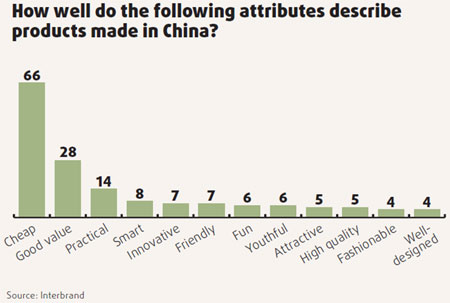
If you are producing high quality products in China you will have a hard time beating the low cost low quality perception. This strong negative "country of origin" effect is shown in a research by Interbrand consultancy.

Chinese companies must improve their quality and brand image to gain a competitive edge in the global arena, according to a recent survey by London-based Interbrand Consultancy. The “Made-in-China” survey interviewed over 700 business professionals on their perceptions about products made in China and the potential for Chinese brands going overseas. The survey revealed that Chinese brands were unable to cash in on the Olympics goodwill largely due to the tainted milk powder scandal. “Products made in China continue to represent the image of cheap price but low quality with safety problems,” the survey said.


http://nation-branding.info/2009/01/14/made-in-china/

How to change a good advert into a bad one with 10 rules

The proces by which a good advertising changes into a bad one.
Simply apply all the rules of good advertising without bearing in mind the effect on the impression on the viewer. During the proces you lose sight of the origial big idea to visualize the intended positioning.
An outdated example, but this kind of advertising is still widespread.


13 September 2010

The Variables of 'Like' Brands go to great lengths for Facebook fans

Back in 2006, Mentos became an early leader among brands in social media when it capitalized on two performance artists posting videos of what happens when you put the candy in Diet Coke. (Explosions.) After the resulting YouTube viral phenomenon, Mentos embraced the creators and rode a wave of viral buzz while Coke issued a dour statement that it wasn't amused.


Fast-forward to 2010. Coke now ranks as the third most popular brand on Facebook with 11.3 million fans. Mentos, as of March, had only 10,000 fans. But then its agency, Isobar, in an effort to play catch-up, paired a two-for-one offer with a pricey reach block on Facebook -- it can cost over $500,000 to reach every Facebook user for a day -- and Mentos saw its number of fans grow to 120,000 in a single day.


Brands that are only now establishing themselves on Facebook are playing a desperate game of catch-up. They're pulling out the stops to rack up what Facebook now calls Likes, social actions by which consumers express interest in a brand. To get Likes, they're going beyond ads and bartering for friendship with offers of exclusive content, discounts and special offers.  
..........Read more ......

http://www.adweek.com/aw/content_display/news/digital/e3iafc531ef3af052c79c14f214db8bd30d