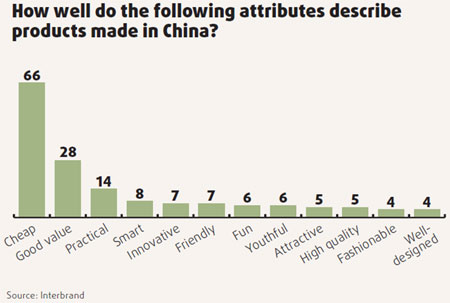
If you are producing high quality products in China you will have a hard time beating the low cost low quality perception. This strong negative "country of origin" effect is shown in a research by Interbrand consultancy.
Chinese companies must improve their quality and brand image to gain a competitive edge in the global arena, according to a recent survey by London-based Interbrand Consultancy. The “Made-in-China” survey interviewed over 700 business professionals on their perceptions about products made in China and the potential for Chinese brands going overseas. The survey revealed that Chinese brands were unable to cash in on the Olympics goodwill largely due to the tainted milk powder scandal. “Products made in China continue to represent the image of cheap price but low quality with safety problems,” the survey said.
http://nation-branding.info/2009/01/14/made-in-china/
In my work as a marketing lecturer at the business department of the Hogeschool Windesheim, a Dutch University of Applied Sciences, I come across so many interesting aspects of marketing that I have decided to start a blog. Here you will find my personal completely random collected links, articles, video's, opinions and more. Enjoy.
Showing posts with label intercultural marketing. Show all posts
15 September 2010
Country of origin effect
Labels:
branding,
brands,
intercultural marketing,
positioning
A Great Bargain or a Big Rip-off? Consumers' Perceptions of Price Fairness in the U.S. and China
How cultural differences affect consumer price fairness perceptions. An interesting research article shows the differences in perception of price fairness between the US and China. The findings are in line with the Hofstede theory on cultural dimensions. China is a relationship oriented collective society where as the US is a society which scores high on the individuality dimension.
Researchers found that American consumers in general tended to see things as fair if they got the bargain and unfair if they didn't, regardless of whether the shopper they were being compared to was a friend or a stranger. Chinese consumers, on the other hand, cared more about how they stacked up against their friends. "The Chinese were less affected by what a stranger paid than what a friend paid, whereas Americans were uniformly sensitive to price discrimination,' the researchers report.
They also explored whether customers' relationship with the seller -- first-time buyer versus loyal customer -- affected their feelings of fairness in the price they paid. For American consumers, it did not seem to matter much whether they were a first-time or loyal customer: It was fair if they got a lower price and unfair if they paid more regardless of their relationship with the seller. Chinese consumers, on the other hand, tended to be more bothered if they paid a higher price as a loyal customer. Chinese consumers "were more sensitive...to the nature of the vendor-customer relationship."
http://knowledge.wharton.upenn.edu/article.cfm?articleid=1906
Researchers found that American consumers in general tended to see things as fair if they got the bargain and unfair if they didn't, regardless of whether the shopper they were being compared to was a friend or a stranger. Chinese consumers, on the other hand, cared more about how they stacked up against their friends. "The Chinese were less affected by what a stranger paid than what a friend paid, whereas Americans were uniformly sensitive to price discrimination,' the researchers report.
They also explored whether customers' relationship with the seller -- first-time buyer versus loyal customer -- affected their feelings of fairness in the price they paid. For American consumers, it did not seem to matter much whether they were a first-time or loyal customer: It was fair if they got a lower price and unfair if they paid more regardless of their relationship with the seller. Chinese consumers, on the other hand, tended to be more bothered if they paid a higher price as a loyal customer. Chinese consumers "were more sensitive...to the nature of the vendor-customer relationship."
http://knowledge.wharton.upenn.edu/article.cfm?articleid=1906
14 September 2010
International branding. A global or local marketing campaign ?
One of the important questions in an increasing globalizing world. "Should a globally sold product have a global marketing campaign or does it have to be localized ?"
A nice example of a localised bollywood style XBOX360 Indian TV commercial featuring Akshay Kumar & Yuvraj singh.
xbox360 bollywood style
A nice example of a localised bollywood style XBOX360 Indian TV commercial featuring Akshay Kumar & Yuvraj singh.
![]() |
| Enjoy the ride. |
xbox360 bollywood style
Subscribe to:
Posts (Atom)

